
Shisha buyer guide · Article 222
Charcoal Particle Size and Shisha Cube Uniformity: What Buyers Should Check
Connect cube texture, piece-mass variation, cracks and dust to the evidence worth reviewing. Keep particle-size hypotheses separate from verified production data and finished-product results.
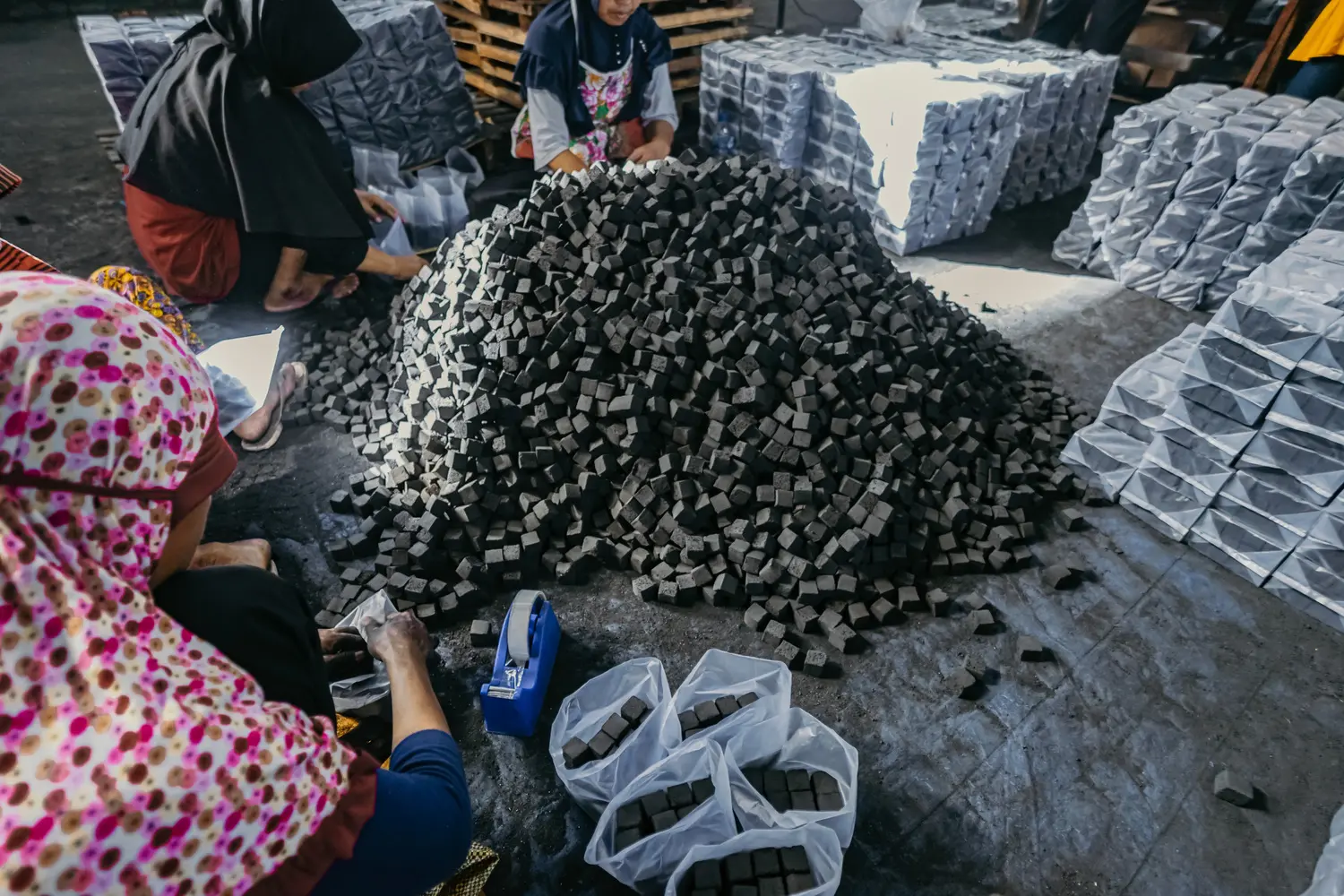
01 · Separate particle size from cube size
One describes the input; the other describes the finished piece.
Charcoal particle size describes the size distribution of prepared charcoal before it is formed into a briquette. Shisha cube size describes the external dimensions of the finished product. A cube measurement does not reveal the particle distribution inside it, and two similarly sized cubes need not share the same preparation history.
Particle preparation may influence how the mixture packs and how uniform its structure becomes. However, a finished cube also reflects mixing, binding, forming and drying conditions. Treat a suspected particle-related issue as a question to investigate, not a diagnosis based on rough texture or a broken edge.
For buyer approval, define uniformity through observable requirements: dimensions, individual piece mass, visible condition, handling behavior and performance under an agreed test. Keep the production explanation separate from whether the identified sample meets those requirements.
02 · Read production evidence in its proper scope
A process variable is not a universal quality ranking.
A published coconut-shell charcoal screw-extrusion study by Anis and colleagues compared several particle-size groups and measured physical and thermal properties. The results support investigating particle preparation as a process variable. They do not establish a universal ideal mesh number for every shisha cube or document the current Unimax process.
FAO’s general charcoal-briquetting guidance describes preparing charcoal fines, combining them with binder, forming and drying. That sequence reinforces why a buyer should examine the whole process rather than assign every finished-product difference to grinding alone. It is general background, not a shisha product specification.
Ask which preparation stage the supplier is describing and whether the stated size refers to a screen opening, a nominal mesh designation, a passing fraction or a measured distribution. Request the units, method and sampling point. A lone mesh number without its meaning is a weak basis for comparing suppliers.
A buyer can request a process-control summary or redacted size-check record without demanding confidential settings or recipes. If the record cannot be shared, agree an alternative review and state what remains unverified. Do not publish an assumed particle range as a supplier fact.
03 · Make finished-cube observations comparable
Record what happened before suggesting why.
Use identified samples with product, lot and carton references. Define how many distinct cubes will be examined, how they are selected and how results will be recorded before comparing them. Keep repeated readings separate from the count of individual pieces.
Measure dimensions and piece mass using the same tools, units and procedure for each sample group. Retain individual readings as well as any summary. If comparing mass between groups, account for external dimensions and documented conditioning; mass differences alone do not establish particle-size differences.
For visible texture, chips or cracks, use consistent lighting, a scale reference and the same viewing conditions. State whether a surface was already exposed, naturally broken in the pack or deliberately opened for examination. Deliberately breaking a cube creates a different observation from damage found before handling.
Record loose dust at a defined stage, with the pack condition and handling history. Do not equate dust collected after transport with the size distribution of the material entering the press. Likewise, a smooth surface is an appearance observation, not proof of internal homogeneity.
04 · Use the observation-to-evidence table
Keep several explanations open until records narrow them.
The table below translates buyer observations into follow-up requests. Its possible contributors are investigation prompts, not confirmed causes or an exhaustive failure analysis. Start with the original sample identity and reproduce the observation where appropriate before requesting a production change.
Ask for records linked to the relevant material group and production batch where available. A current equipment photograph may help orient a discussion, but it cannot demonstrate the particle distribution used for an earlier shipment. A generic procedure also cannot prove that a particular batch followed it.
If a supplier proposes changing particle preparation, ask what else will change and how the trial will be identified. Compare the resulting cubes under the same agreed method. When several variables change together, a better result does not isolate which change caused the improvement.
For a hypothetical example, two lots may have similar measured dimensions while one contains more chipped edges. The immediate buyer finding is a difference in edge condition under the recorded inspection. Review packing and handling history, forming and drying records, and available preparation checks before assigning a cause.
05 · Approve outcomes and document process changes
Turn the review into an order-specific decision.
Agree the finished-product acceptance basis with the supplier: required observations, test methods, sample selection and the person authorized to approve an exception. This guide supplies no default particle range, defect limit or performance guarantee. Missing evidence should remain pending rather than be recorded as a favorable result.
Keep the approved sample reference, reviewed process evidence and open questions together. For repeat orders, ask how a material-preparation change affecting the agreed product will be communicated and evaluated. Record the trial reference and decision instead of treating a new process description as automatic approval.
PT Unimax Pro Indonesia has equity ownership and operational control in the production facility. Factory visits and live factory video calls are available. Discuss current product requirements and the production evidence relevant to your inquiry; this page does not report current particle-size measurements or a validated process recipe.
Use the sample-to-production guide to connect an approved reference to the supplied goods. Use the raw-material variation guide for the broader consistency review. Particle preparation belongs within that evidence chain; it cannot replace finished-product evaluation.
Buyer tool · observation to evidence
What did you observe, and what evidence would explain it?
Supplier / product ___; lot / carton / sample IDs ___; observation date ___; method / equipment ___; distinct pieces examined ___. Keep the original finding, possible contributors and verified conclusion in separate fields.
| Buyer observation | What it establishes | Possible contributors to review | Evidence to request / record |
|---|---|---|---|
| Uneven visible texture | Appearance differs under the recorded viewing conditions | Preparation or mixing differences; surface formation may also matter | Dated preparation / mixing check; identified sample views; batch linkage ___ |
| Variation in piece mass | Individual readings differ; compare dimensions and conditioning too | Forming, mixture or drying differences; investigate measurement first | Raw mass / dimension readings; conditioning; available production checks ___ |
| Chipped edges or cracks | Record affected pieces and whether damage preceded examination | Forming, drying, packing or handling; particle preparation is one hypothesis | Pack condition / transport history; defect photos; linked process records ___ |
| Loose dust in a pack | Dust observed at a defined opening or handling stage | Abrasion, breakage or packing residue; not a direct feedstock-size result | Dust observation method; handling stage; pack IDs; preparation record if relevant ___ |
| Visible internal differences | Describe the exposed face and how it was exposed | Mixing or forming variation; appearance alone cannot identify composition | Consistent sample views; agreed examination method; linked control checks ___ |
| Different burn behavior | Result differs under the agreed test conditions | Several product and test variables; size preparation is not established as cause | Matched test records; cube dimensions / mass; sample identity; process review ___ |
| Supplier quotes a mesh number | A stated input-size description, not a finished-product guarantee | Meaning depends on method, fraction and sampling point | Screen opening / designation; units; passing or retained basis; date / sample ___ |
| Improvement after a trial | Identified trial performs differently under the comparison method | Cause remains uncertain if multiple variables changed | Change list; trial / control IDs; comparable results; approval record ___ |
Investigation and decision record
Finding / photo IDs ___; original observation ___; hypotheses ___; records reviewed and batch linkage ___; comparison method ___; supported conclusion ___; remaining uncertainty ___; required action / owner / date ___; buyer approval or hold reference ___.
Particle size and uniformity questions
Is a finer charcoal powder always better for shisha cubes?
This guide establishes no universal ideal particle size. Review the preparation method, product requirements and identified trial results within the actual process.
Can a cube photograph prove particle-size distribution?
No. A photograph documents visible appearance. Request a defined particle-size check and its sample or batch reference for a distribution claim.
Does loose dust mean the original powder was too fine?
No. Record the opening and handling stage, damage and pack condition. Loose dust does not by itself identify the size distribution entering production.
What should a buyer ask for instead of a recipe?
Request the relevant control summary, measurement method, linked records and evidence of finished-product conformity. Agree redacted evidence where necessary.
Technical background and its limits
Anis and colleagues: Effect of Biomass Feedstock Granulometry on Thermophysical Characteristics of Charcoal Briquettes via Screw Extrusion — a process-specific coconut-shell briquette study, not a Unimax product report or universal shisha specification.
FAO: Briquetting of charcoal, Chapter 11 — general process background; its formulations and applications are not presented here as shisha requirements.
Commercial discussion
Discuss the production evidence your buying decision needs.
Share your destination, shisha product requirements, intended volume and the control points you want to review. Discuss available production evidence, current specifications and a qualified live factory call.
Discuss production evidenceFactory and quality evidence · About PT Unimax Pro Indonesia · Shisha charcoal products · Contact Unimax
Related buyer guides
Match approved samples to production · Raw-material variation and batch consistency · Factory audit checklist for buyers